Document Processing
Extract order numbers and line items from incoming documents. Check them against known records and send discrepancies to a reviewer alongside the source document.
AI & Workflow Automation
Combine practical automation, business rules, software integrations, and carefully evaluated AI capabilities to reduce manual effort and improve operational workflows.
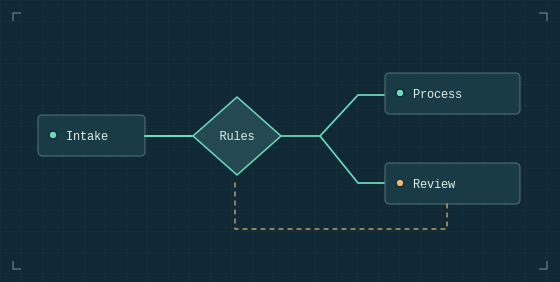
CatchFoundry has delivered AI projects and custom software integrations. We start a new engagement by following one item from arrival to completion. Where is information copied, where does someone make a judgment, and what happens when a required field is missing?
A clear rule can handle a predictable decision. An AI component can help interpret a variable input, such as a supplier document, when there is a way to check its output. We decide which approach fits at each step.
Illustrative use cases
Extract order numbers and line items from incoming documents. Check them against known records and send discrepancies to a reviewer alongside the source document.
Route an approved request to the correct team, create the corresponding work item, and record the handoff so staff can see who owns the next step.
Suggest a category for incoming information, then validate required fields with business rules. Record corrections so the team can evaluate recurring errors.
Connect service requests, CRM records, and fulfillment updates. Give staff a shared status and route time-sensitive exceptions to an owner.
Explore systems integrationHelp staff locate relevant procedures in approved sources. Link answers to the underlying material and respect the access permissions on each document.
Illustrative project · supplier operations
A fictional distributor receives purchase orders as PDFs. Staff retype each line into the ERP and chase missing item codes. A useful first release would prepare a draft order and show reviewers exactly which fields need a decision.
The intake service preserves the original document, extracts line items, and checks customer, unit, and price references against the ERP. A reviewer sees the source alongside the draft. Unmatched items enter an exception queue, and an approved document can create only one order.
At launch, the operations lead would receive a tested replay procedure, a list of conditions that require review, and a report comparing handling time and correction rates with the manual process.
“A case and a single unit can share a very similar description. Seeing the buyer’s original line next to the suggested item is what would let me approve the order with confidence.”
The figures use invented volumes and review times. A pilot would measure both with your team and account for software, monitoring, and support costs.
Independent research
A 2025 study in The Quarterly Journal of Economics examined an AI assistant used by 5,172 customer-support agents. The researchers found a 15% average increase in issues resolved per hour, with gains varying across workers. Read Brynjolfsson, Li, and Raymond’s study.
For a support pilot, we would track resolutions per hour alongside reopened cases and answer quality. For document intake, approved records per hour and correction rates are more informative. The measure should follow the work.
An automation needs an owner, a test set, and a route back to a person. The cost of a wrong answer helps determine where a suggestion is useful and where approval is essential.
Discuss an automation pilotIdentify sensitive fields, permitted data destinations, and who can access inputs and outputs. Review processor and retention requirements before connecting live systems.
Include incomplete documents, unfamiliar layouts, duplicates, and ambiguous cases. Compare outputs with reviewed examples and set acceptance criteria that reflect the workflow’s risk.
Route unclear or high-impact decisions to a named role. Make the source, suggested action, and correction history available for review. Monitor changes in input quality after rollout.
Choose a repeatable task with a clear owner, accessible examples, and a measurable baseline such as handling time or exception volume. A small pilot helps test the value and operating effort.
No. A deterministic rule, scheduled job, or direct integration often handles structured work. AI is an option when interpreting language or variable documents adds value and its outputs can be evaluated.
The workflow can pause, preserve the original input, and request human review. We agree on triggers and authorized reviewers before enabling automated downstream actions.
Compare a representative set of tasks before and after the pilot. Review accuracy, time spent correcting exceptions, processing costs, and the effect on the people doing the work.
Walk us through a routine task, its exceptions, and the person responsible for the outcome. We’ll look for a focused automation opportunity.